Minting history regarding the three pence denomination spans from the Tudor period until the decimal transition in 1971.
Particular attention focuses on the rare threepence dates — transition from circular silver discs to multi-sided forms.
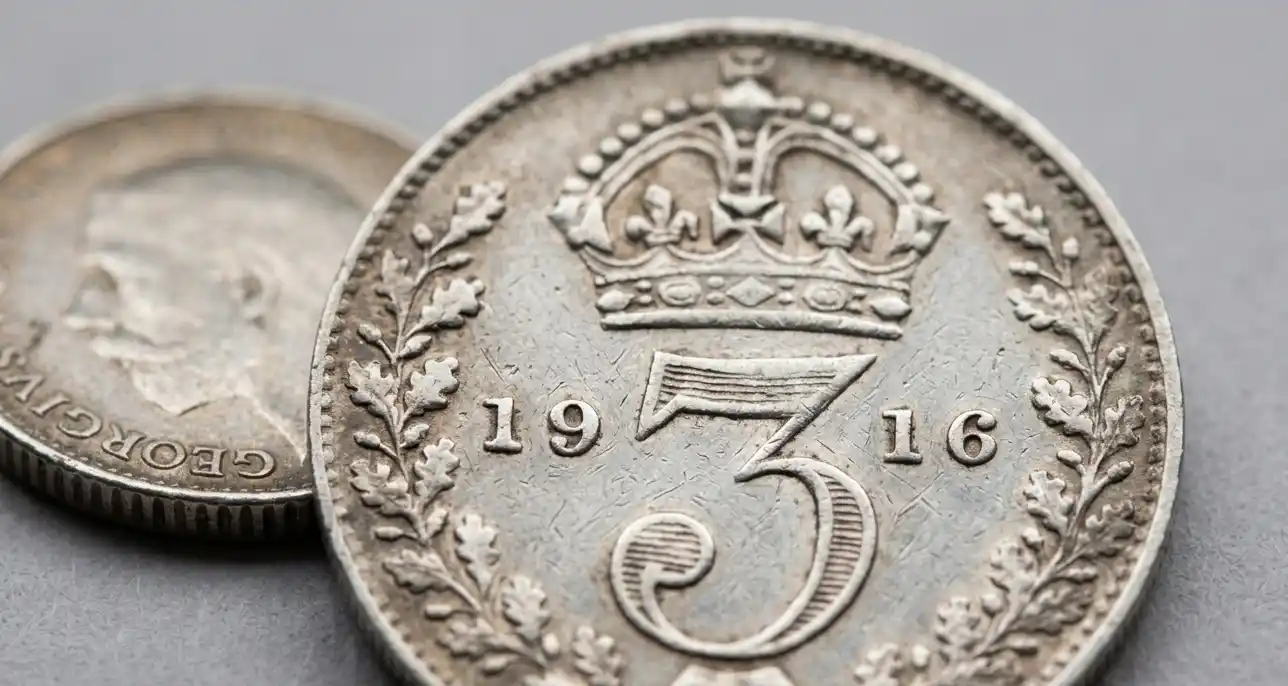
This denomination served as a primary settlement tool in British retail trade for centuries.
Every change of monarch involved updating portrait characteristics and heraldic symbols.
Using precise measuring instruments confirms the authenticity of historical specimens.
Weight and alloy composition changed depending on economic conditions and monetary reforms.
| Parameter | Silver Type before 1920 | Silver Type 1920-1946 | Nickel-Brass Type |
| Face Value | £0.0125 | £0.0125 | £0.0125 |
| Metal | 92.5% Silver | 50% Silver | Copper-Nickel-Zinc |
| Mass | 1.41 grams | 1.41 grams | 6.80 grams |
| Shape | Circle | Circle | 12-sided |
| Diameter | 16.00 mm | 16.00 mm | 21.80 mm |
Adhering to these weight norms guarantees the absence of counterfeits in private collections.
Market Value Dynamics 2021–2026
Investment potential within British numismatics demonstrates steady growth in the current decade.
Percentage price change correlates with the inflation index and demand for physical assets.
Annual price change for MS65 category: 2021 → £120 2022 → £132 (+10%) 2023 → £145 (+10%) 2024 → £162 (+12%) 2025 → £185 (+14%) 2026 → £215 (+16%)
Reasons for value reduction when grade drops:
- Transition MS65 → MS60: 35% price loss
- Transition MS60 → VF20: 75% price loss
- Presence of deep scratches: 50% reduction from market price
Rare mint years ignore general trends, showing growth up to 40% per year.
Registry of Exceptional Specimens and Auction Records
Identifying rare die pairs increases the final lot price at public auctions.
Silver coins from the Edward VIII period represent the peak of rarity due to their cancelled production.
Sales statistics 2025-2026:
- 1937 Edward VIII (Nickel-Brass): £48,000 (Heritage)
- 1945 Silver Type (Pound): £32,500 (Spink)
- 1927 Proof Set Threepence: £2,400 (eBay)
- 1893 Jubilee Head (Victoria): £1,150 (DNW)
Lot price forms based on preserved mint luster.
Absence of circulation marks on the coin field increases the probability of a record sale.
Wear Mechanics and Relief Preservation
Contact with other metal objects causes irreversible deformation of soft Silver.
Surface degradation process happens sequentially and predictably.
Structure destruction chain: Minting → Micro-scratches during transport → Abrasion of portrait hair → Darkening of metal → Total loss of legend details
Using holders made of inert plastic slows these processes down.
Chemical cleaning of a coin destroys the original patina, lowering the price by 80%.
Comparative Design Analysis by Period
Visual execution of the reverse reflects cultural codes of the corresponding era.
Geometric complexity of the 12-sided coin was introduced for easy recognition by touch.
Design elements:
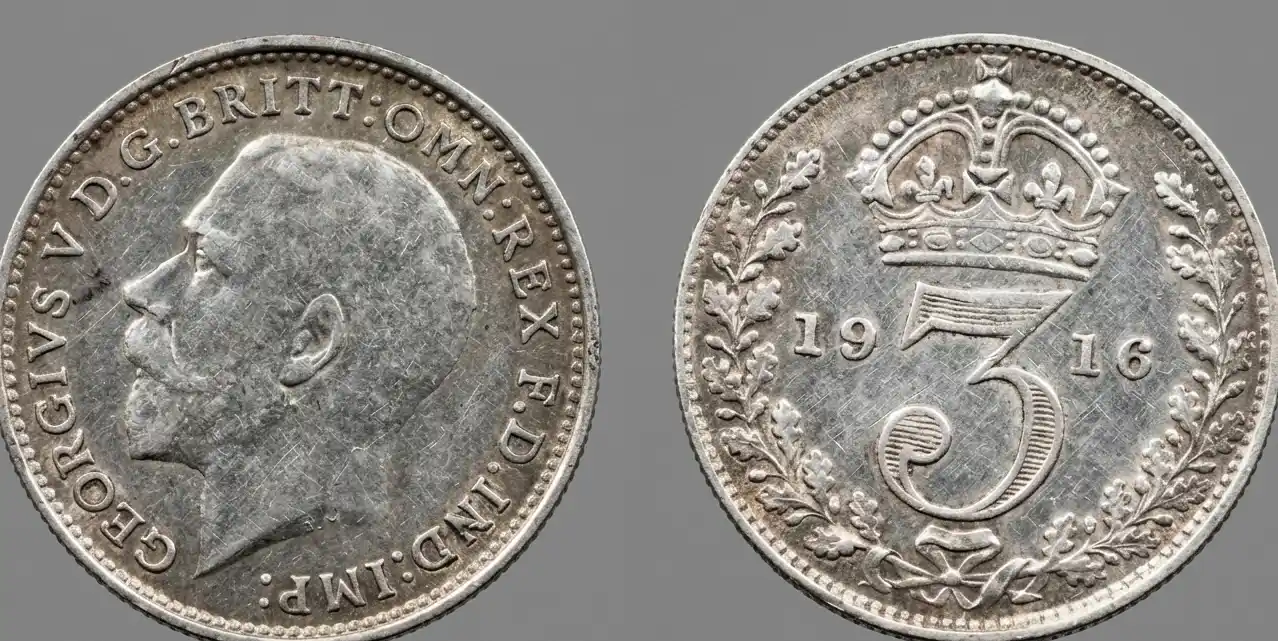
- Victorian type: crowned number 3 inside an oak wreath
- George V: oak branches with acorns
- George VI: Thrift plant or three crowns
- Elizabeth II: crowned rose or Portcullis gate
Clarity of lines on the rose petals serves as a marker for determining the AU58 grade.
Smoothed edges of letters indicate prolonged stay in circulation.
Rarity Factors: Mintages and Survival
Total output volume does not always determine market scarcity.
Mass melting of silver coins in 1947 destroyed most of the earlier issues.
| Year of Issue | Mintage (pcs) | Survival % | Status 2026 |
| 1944 Silver | 1,200,000 | 0.05% | Rarity |
| 1945 Silver | Unknown | 0.01% | Extreme Rarity |
| 1951 Nickel | 1,200,000 | 15% | Scarce |
| 1970 Proof | 750,000 | 95% | Common |
Low survival of 1944 silver coins stems from their usage in colonies.
Specimens lost in tropical climates show signs of corrosion.
Classification by Die State
Condition of the working tool at the mint affects the sharpness of small details.
Late strikes from cracked dies form raised lines on the field.
Die wear markers:
- Blurriness of the FID DEF inscription
- Absence of pearls in the monarch’s crown
- Metal flows around the portrait
- Shifting of the image center
Presence of a mint error can increase coin value 3-5 times.
Specimens with a double strike or a 180-degree rotation are particularly valued.
Investment Risks and Authenticity Verification
The 2026 market remains flooded with high-quality copies from China.
Checking metal density allows for excluding the use of non-precious alloys.
Signs of forgery:
- Soapy relief appearance lacking sharp edges
- Absence of a ringing sound when dropped on a hard surface
- Weight discrepancy exceeding 0.05 grams
- Presence of casting seams on the edge
Certification in independent laboratories confirms the stated characteristics.
Professional expertise costs from £30 to £150 depending on service speed.
Patina Influence on Collectible Value
Oxide layer on the Silver surface forms over decades.
Rainbow patina counts as a sign of proper storage in old cabinets or paper envelopes.
Patina color gradations:
- Light golden: minimal age
- Blue-green: storage in oak cabinets
- Deep black: aggressive environment or high humidity
- Multicolored: most valuable for auctions
Removing patina deprives the coin of historical context.
Collectors at 2026 auctions pay a premium up to 30% for natural color.
Interconnection Between Shape and Edge Wear
Twelve-sided structure of nickel-brass coins protects the central relief.
Faceted edges take the primary impact during a fall.
Wear resistance comparison: Circular shape → Uniform abrasion of the whole field → Fast loss of denomination Multi-sided shape → Wear concentration on corners → Preservation of the center
This explains the large number of preserved Elizabeth II coins in high quality.
Silver coins lose up to 2% of mass over 10 years of active circulation due to softness.
Technical Aspects of 19th Century Minting
Usage of Boulton’s steam presses ensured unprecedented accuracy.
Introduction of collar minting allowed standardizing diameter to fractions of a millimeter.
Production stages: Blank preparation → Cleaning in acid baths → Die strike under 40 tons of pressure → Inspector check
Presence of adjustment marks on the blank counts as acceptable for early issues.
Scratches from a cleaning brush at the mint reduce the grade by one step, you can check your own with the coin identifier app.
Role of Mint Marks in Pricing
Most three pences were struck in London without special marks.
Using capacity from third-party plants was noted with letters on the reverse.
Mint location identifiers:
- Absence of mark: London Mint
- Letter H: Heaton Mint in Birmingham
- Letter KN: Kings Norton
Rarity of coins with the KN letter is higher due to small mintages in war years.
Finding such a mark under the date increases the specimen price 2.5 times.
Asset realization speed depends on correctly identifying its market niche.
Certified coins sell significantly faster than unauthorized ones.
| Category | Selling Period | Market Status |
| Rare dates (MS60+) | 1-3 days | High liquidity |
| Victoria Silver (VF) | 1-2 weeks | Medium liquidity |
| Nickel-Brass (Circulated) | 1 month | Low liquidity |
| Silver scrap (Below G4) | Instantly | Metal price |
Investors are advised to form a portfolio from positions in the first row.
The second row suits long-term collecting without the goal of quick profit.
Conclusion
The British three pence represents a complex object for study and investment.
Combining metallurgical value and historical design makes it unique.
The 2026 market confirms price stability for rare dates and shapes.
Careful selection of specimens without defects guarantees capital growth.
Using data from this report minimizes risks during purchase.
Final evaluation of a coin always requires visual confirmation from an expert.
Further study requires referring to the Royal Mint archives.
Only verified facts should form the basis of investment decisions.